
If you’ve followed The GO Deck for a while, you already know that I believe time outdoors is far more than recreation. Nature helps us think more clearly, feel calmer, connect more deeply with others, and experience moments of awe that are increasingly rare in modern life.
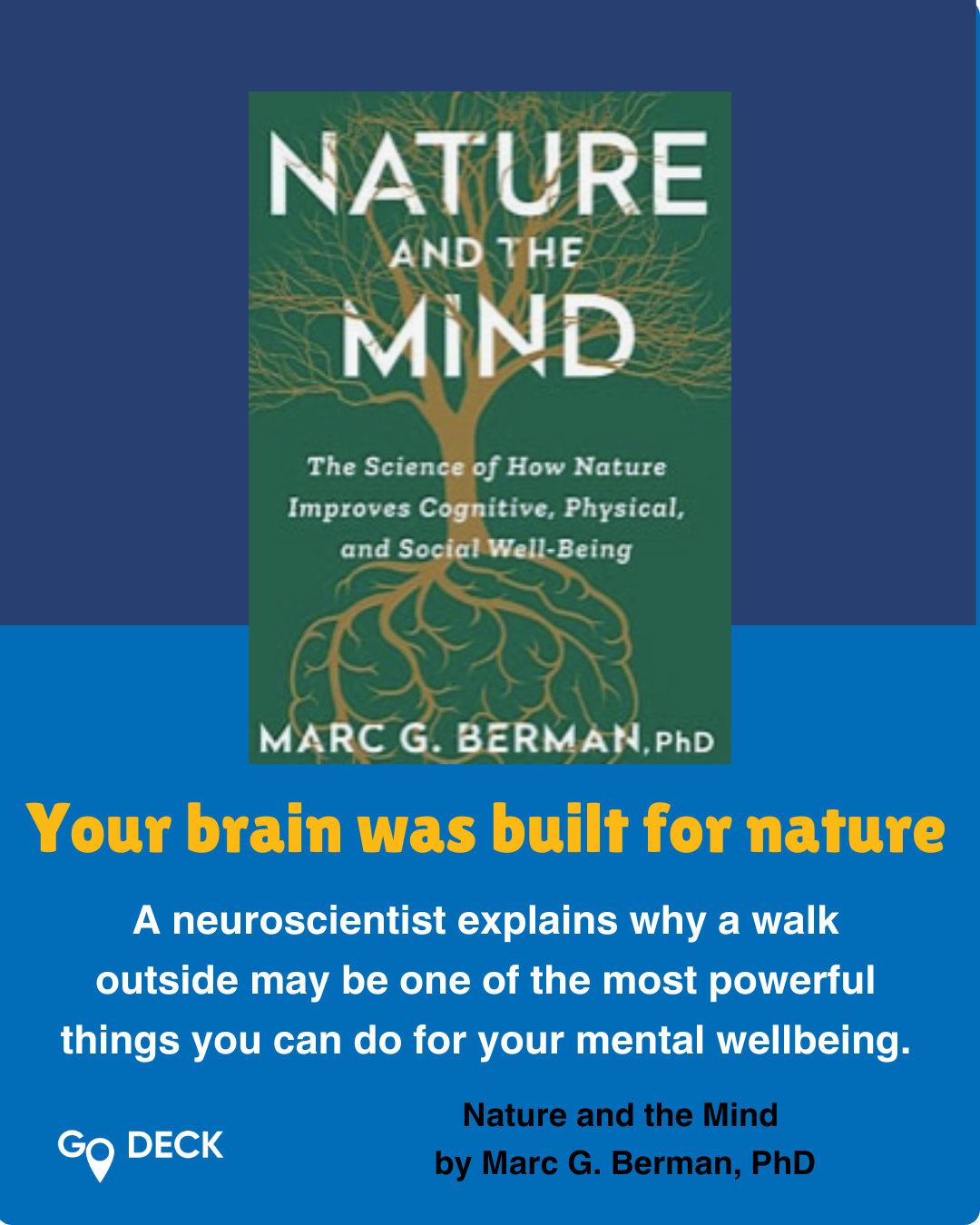
That’s why I enjoyed reading Nature and the Mind by cognitive neuroscientist Dr. Marc Berman.

In his thoughtful and research-backed book, Dr. Berman explores how natural environments influence the human brain—and why our growing separation from nature may be contributing to many of the mental and emotional struggles people face today.
The book combines neuroscience, psychology, public health research, and urban planning into a compelling argument: humans are not designed to spend all day indoors, overstimulated, and disconnected from the natural world.
Below are a few of the key ideas that stood out most to me.
Nature Restores Mental Energy
One of the central themes of the book is the idea of “attention restoration.”
Modern life constantly demands our focus. Notifications, traffic, emails, screens, advertisements, and endless decision-making leave our brains mentally fatigued. Dr. Berman explains that nature provides a different kind of attention experience—one that is gentle rather than demanding.
Natural settings engage what researchers call “soft fascination.” Instead of forcing concentration, nature effortlessly captures our attention through movement, texture, water, birdsong, trees, clouds, and changing light.
As a result, time outdoors helps restore our ability to focus.
This idea will likely feel familiar to anyone who has ever gone for a walk when overwhelmed and returned feeling mentally lighter and clearer afterward.
You Don’t Need Wilderness to Benefit
One of my favorite aspects of the book is that Dr. Berman emphasizes accessible nature.
The benefits of nature exposure aren’t limited to national parks or remote hiking trips. Research shows that nearby green spaces, tree-lined streets, local parks, waterfront paths, community gardens, and neighborhood trails can meaningfully improve mental wellbeing.
That message aligns perfectly with why I created The GO Deck in the first place.
Many people assume outdoor adventure must involve expensive gear, long drives, or elaborate planning. But some of the most meaningful experiences happen surprisingly close to home. Often, the hardest part is simply knowing where to go (pun intended).
Dr. Berman’s work reinforces that small, regular interactions with nature matter, and they add up over time.
Nature Supports Emotional Wellbeing
The book also explores how spending time outdoors can reduce stress and support emotional health.
Natural environments appear to help calm the nervous system, lower mental rumination, and create space for reflection. Dr. Berman discusses how nature can interrupt repetitive negative thinking patterns that are common during periods of stress, anxiety, or emotional overwhelm.
That doesn’t mean nature “solves” every problem. But it can create conditions that help people breathe a little easier, process emotions more gently, and feel more grounded.
I think this is one reason walks with friends can feel so healing. Sometimes people don’t want advice or solutions. They simply want company. A scenic trail, waterfront path, or quiet park creates an environment where conversation can flow naturally—or silence can feel comfortable instead of awkward.
Our Brains Were Built for Nature
Another fascinating point throughout the book is that the human brain evolved in natural environments for most of human history.
In many ways, our modern environments are evolutionarily mismatched with what our minds and bodies were designed to handle. Constant noise, dense visual clutter, artificial light, and nonstop stimulation may contribute to cognitive overload.
Nature, on the other hand, offers patterns and sensory experiences the brain appears to process more efficiently and comfortably.
This helps explain why so many people instinctively feel calmer near water, under trees, or on a quiet trail.
Final Thoughts
Rather than framing nature as something separate from everyday life, Dr. Berman shows that reconnecting with the outdoors—even in small ways—can meaningfully support our mental, emotional, and cognitive wellbeing.
If you’re interested in the science behind why nature feels restorative—and why spending more time outdoors may be one of the healthiest habits we can build—I highly recommend adding Nature and the Mind to your summer reading list.



Share:
Meet the People Behind The GO Deck: Sophie Caoili
Meet the People Behind The GO Deck: Caylin Rodgers