
After reading several books explaining the science behind nature's benefits, I found myself asking a different question: What happens once we actually start paying attention?
There are the birds in our neighborhood, the changing seasons (well, kinda in San Diego), the insects visiting flowers, the wildlife that passes by our offices or front yards...
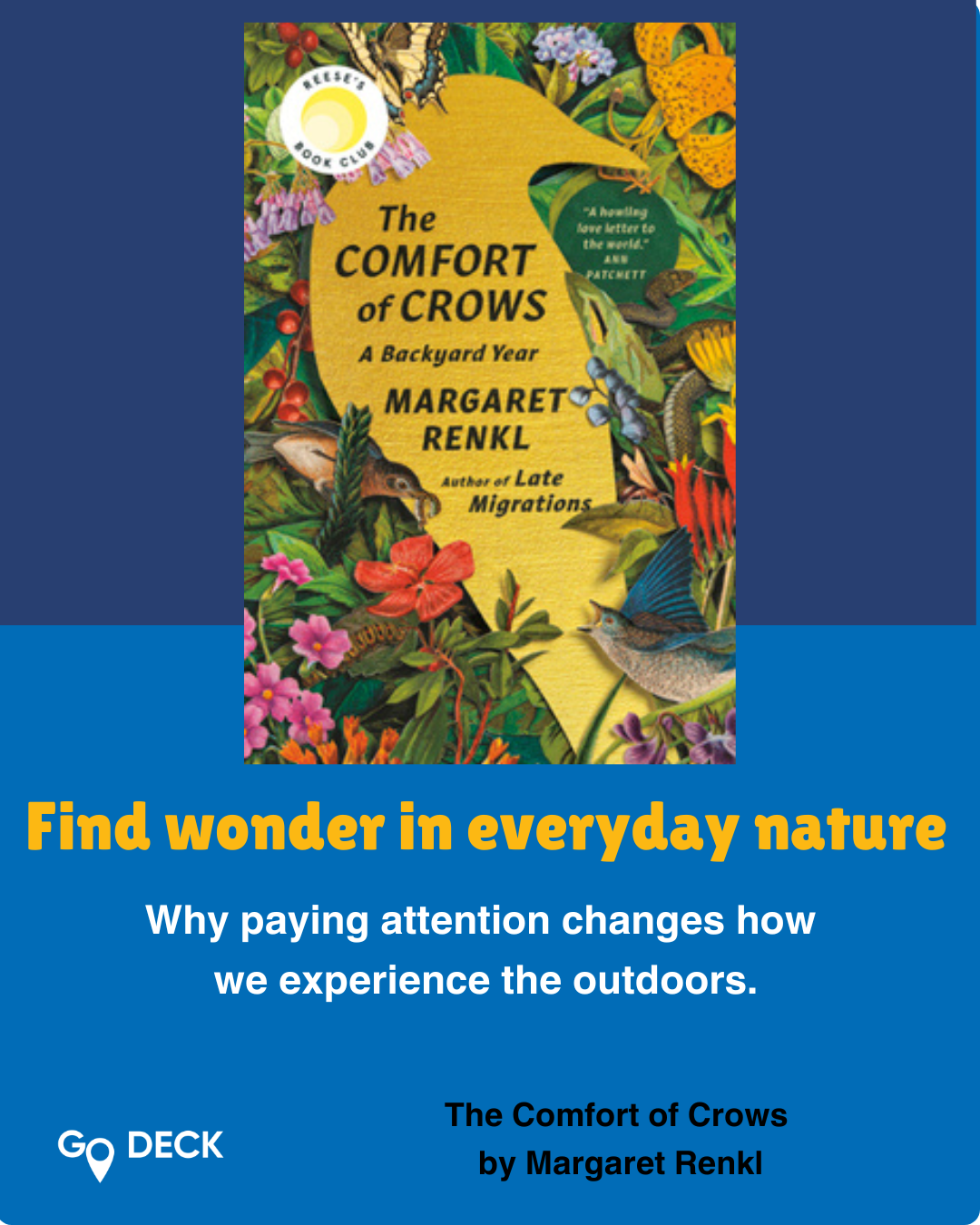
Margaret Renkl's The Comfort of Crows is a book about paying attention to those kinds of things.
Unlike many nature books, this isn't a guide to faraway wilderness adventures or exotic species. Instead, Renkl invites readers to discover the extraordinary stories unfolding in ordinary places. The result is a beautiful reminder that wonder isn't something we have to travel to find - it's often right outside our door.

The Big Idea
At its core, The Comfort of Crows is about learning to notice.
Structured around the changing seasons, the book follows a year of observations from Renkl's backyard and local surroundings. Along the way, she reflects on birds, insects, plants, weather, family, loss, joy, and the interconnectedness of life.
What makes the book so powerful is its perspective. Renkl doesn't treat nature as something separate from everyday life, and that's a misconception and challenge that I think many people face.
As we get caught in our day-to-day routines, we have stopped noticing the nature around us, and we find taking a pause to observe nature difficult. There's so much to do--the dishes, laundry, helping children with homework, catching up on work emails, etc--we can't fit in nature observation into our busy day.
Wonder Hides in Familiar Places
One of the themes that resonated with me most is the idea that familiarity often blinds us.
We tend to assume that interesting things happen somewhere else—in national parks, remote forests, or distant mountain ranges.
Meanwhile, we walk past fascinating stories every day. In the trees along the sidewalk, there's a nesting bird and a squirrel gathering food. In the bushes, there's a pollinator visiting flowers. Or in the case of this book's title, you may find a crow solving problems.
Renkl reminds readers that nature is not less interesting simply because it's nearby. In fact, the more time we spend observing a place, the more remarkable it becomes.
The Power of Seasonal Awareness
Though this is sometimes challenging for me living in San Diego, another lesson woven throughout the book is the value of noticing seasonal change.
Even beyond the "75 and sunny" weather of SoCal, modern life in the United States often keeps us insulated from the rhythms of the natural world. Climate-controlled buildings, digital calendars, and busy schedules can make one month feel much like the next.
Renkl encourages readers to reconnect with those rhythms. We can notice when birds start to migrate, when wildflowers emerge in spring, the chirping of insects as summer approaches, the changing color of leaves in autumn, and then the occasional silence in winter.
These changes become markers of time that help us feel more connected to the places where we live. This book made me realize how much richness exists in simply paying attention to what changes from week to week.
Observation Creates Connection
One of my favorite takeaways from The Comfort of Crows is that observation naturally creates connection.
When we notice something repeatedly, we begin to care about it, and this connection often leads to something even more meaningful: stewardship.
People are far more likely to protect what they know and love, so by encouraging readers to notice the natural world around them, Renkl quietly encourages readers to care about planet Earth as well.
Why This Book Resonated With Me
As someone who spends a lot of time helping people discover local outdoor spaces, I appreciated how closely Renkl's message aligns with what I've observed through The GO Deck.
People often assume they need to travel somewhere spectacular to feel awe and wonder, but some of the most meaningful experiences happen much closer to home. Like when you discover a hidden trail for the first time, or when you explore a neighborhood lagoon and watch the waterfowl gathering at sunset...location doesn't matter; it's the attention we bring to it.
From Information to Observation
Starting with Nature and the Mind, the books I've reviewed so far this summer focus on what science can teach us about nature.
The Comfort of Crows focuses on what nature can teach us directly. It reminds us that not every outdoor experience needs a measurable outcome. Sometimes the value lies in slowing down, observing, and becoming curious.
My Takeaway
The biggest lesson I took from The Comfort of Crows is that wonder exists in ordinary places. The challenge is learning to see it and, sometimes, taking the time to see it.
When I started taking my daughter for walks during the pandemic to just get us out of the apartment, she showed me how nature is everywhere. She stopped to observe a patch of clover, she picked up leaf, after leaf, after leaf...our walks stretched on and on and on....I had to resist the urge to rush.
She taught me to pause....and notice a flower, watch a bird, the list goes on.
I discovered that nature is everywhere, and that's what inspired The GO Deck.



Share:
Meet the People Behind The GO Deck: Laura Roden
Adventure Can Begin in Your Own Backyard: A Book Review of The Backyard Bird Chronicles