
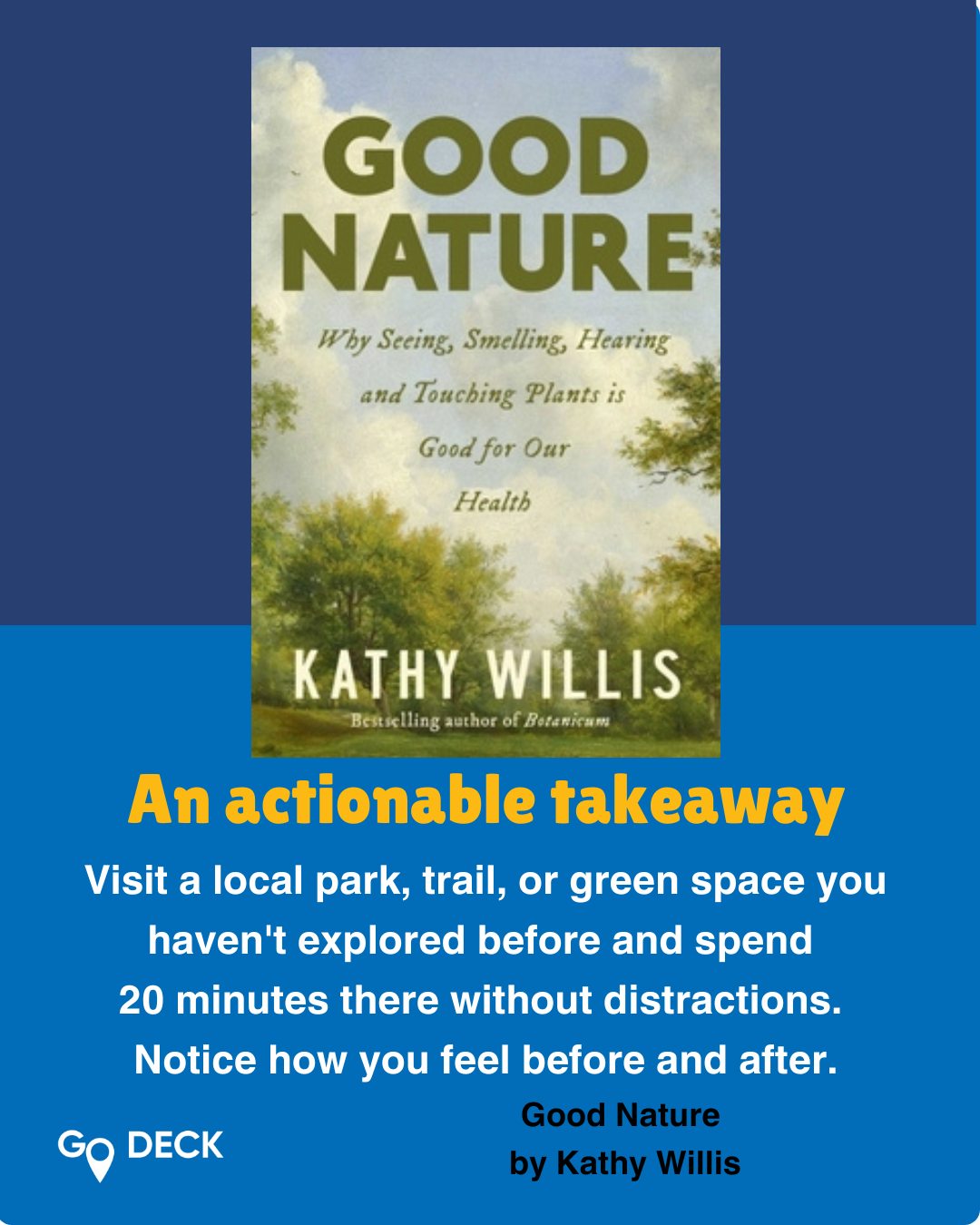
If Nature and the Mind convinced you that spending time outdoors can improve attention, memory, and mental well-being, Good Nature takes the conversation one step further.
Written by physician and public health expert Kathy Willis, this book explores a bigger question: How does nature influence our physical and psychological health?
The answer, according to Willis, is far more profound than most people realize.
Drawing on decades of scientific research, Good Nature examines how interactions with the natural world affect everything from stress hormones and immune function to cardiovascular health, sleep quality, social connection, and longevity. Rather than relying on vague claims that "nature is good for you," Willis carefully explains the biological mechanisms behind those benefits.
For readers interested in evidence-based reasons to spend more time outdoors, Good Nature delivers.

The Big Idea
One of the book's central themes is that humans evolved in close relationship with the natural world. While modern life has brought countless conveniences, it has also reduced our daily contact with the environments that shaped our bodies and brains.
Willis argues that this separation comes with consequences.
The research she presents suggests that regular exposure to nature isn't simply a pleasant lifestyle choice—it's a factor that can influence health outcomes in measurable ways. Nature affects how our nervous systems respond to stress, how our immune systems function, how well we recover from illness, and even how connected we feel to other people.
In other words, nature isn't just scenery. It's part of the environment our bodies expect.
What I Found Most Interesting
1. Nature Helps Regulate Stress
Many of us intuitively feel calmer after a walk through a park, a hike in the woods, or time spent near water. Willis explores the growing body of research explaining why.
Exposure to natural settings has been shown to reduce physiological markers of stress, including cortisol levels, heart rate, and blood pressure. Even brief interactions with nature can help shift the body away from a chronic "fight-or-flight" state.
What makes this particularly relevant today is how much of modern life seems designed to keep us mentally stimulated and physiologically activated. Nature offers a rare opportunity for recovery.
2. Biodiversity May Matter More Than We Think
One of the most fascinating sections discusses the relationship between biodiversity and human health.
Willis highlights emerging research suggesting that exposure to diverse natural environments may influence the microorganisms that live on and within our bodies. These microbial communities play important roles in immune regulation and overall health.
While the science is still evolving, the idea is compelling: preserving healthy ecosystems may benefit human health in ways we are only beginning to understand.
3. Small Doses Count
A common misconception is that meaningful benefits require wilderness adventures or multi-day backpacking trips. Fortunately, the research reviewed in Good Nature suggests otherwise.
Views of trees, neighborhood parks, community gardens, urban greenways, and even small amounts of daily nature exposure can make a difference. Willis repeatedly emphasizes that nature's benefits are often accessible much closer to home than we assume.
For busy families, working professionals, and people living in urban environments, this may be one of the book's most encouraging takeaways.
Why This Book Resonated With Me
One reason I appreciated Good Nature is that it focuses on practical relevance rather than idealized outdoor experiences.
Many books about nature celebrate remote wilderness destinations. Willis certainly acknowledges the value of those places, but she spends much of her time discussing everyday interactions with nature—the trees outside your office window, the neighborhood trail, the local park, or the community green space.
That perspective aligns closely with why I created The GO Deck.
Most people don't need to wait for a vacation to experience nature's benefits. The evidence suggests that regular, nearby outdoor experiences may be some of the most powerful because they're the ones we can actually repeat. Consistency often matters more than distance.
My Takeaway
If Nature and the Mind explains how nature improves our cognitive health, Good Nature expands the conversation to the entire body.
The book presents a compelling case that spending time outdoors is not merely recreation. It's an investment in physical health, mental well-being, and long-term quality of life.
What I appreciated most is that Willis doesn't leave readers feeling overwhelmed. The message isn't that you need to move to the mountains or spend every weekend in the wilderness.
Instead, the science points toward something much more achievable: finding ways to bring nature into everyday life.
A short walk through a local park. Lunch outdoors versus the office cafeteria. Time spent tending to a small plot at a community garden. Exploring a nearby trail you've never visited before (or maybe even just taking it in the opposite direction of your usual routine).
Small actions, repeated consistently, can add up. And according to the research in Good Nature, those moments may be doing far more for our health than we realize.



Share:
52 Outdoor Spots in San Diego You Can Navigate to Right Now
Inventors Digest on Outdoor Adventure: It’s in the Cards