
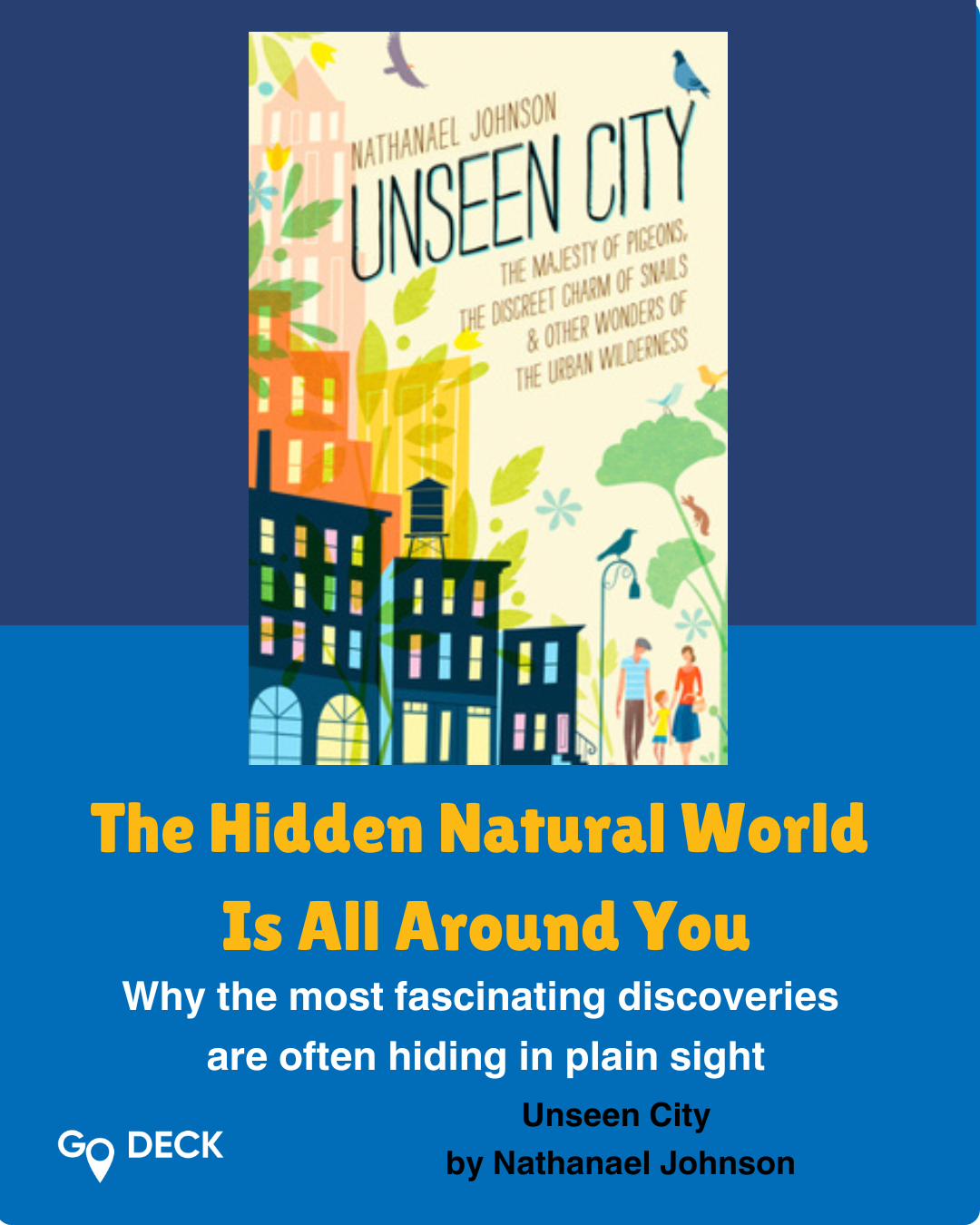
How many times have you walked down the same street, visited the same park, or followed the same trail without noticing anything new?
If you're like me, the answer is probably quite a few. And that's not because there's nothing to see...it's because there's far more happening than we realize.
In Unseen City, science writer Nathanael Johnson invites readers to look more closely at the urban environments they move through every day. Through a blend of science, storytelling, and personal exploration, he reveals the astonishing diversity of plants, animals, insects, fungi, and ecological relationships hidden in plain sight.
The book's central message is both humbling and exciting: the world around us is far more interesting than we think...we simply haven't learned how to see it yet.

The Big Idea
At its core, Unseen City is about developing a deeper awareness of the places we think we already know.
Johnson begins with a simple observation: most of us move through our neighborhoods largely unaware of the natural systems operating around us.
Although we notice roads, buildings, and destinations, nature fades into the background.
Trees are just scenery, and birds are just background noise. Insects are annoyances. Yet each of these seemingly ordinary things contains fascinating stories.
The more Johnson learns about the organisms sharing his city, the more extraordinary his surroundings become. He invites us--the readers--to make the same discovery.
The Invisible Becomes Visible
One of the most enjoyable aspects of the book is watching Johnson transform everyday encounters into moments of wonder. For example, a sidewalk crack becomes evidence of life finding a way.
Again and again, Johnson demonstrates that the ordinary often becomes extraordinary when viewed through a different lens.
Learning the Names Changes Everything
A recurring theme throughout the book is the power of naming.
When something doesn't have a name, it tends to fade into the background. However, once we identify it, it becomes easier to notice again.
A bird is no longer just a bird...it's a crow, finch, hawk, or hummingbird.
A tree is no longer just a tree...it's an oak, sycamore, eucalyptus, or pine.
Johnson argues that naming creates familiarity, and familiarity creates connection. And the more we learn about the natural world around us, the richer our everyday experiences become.
Curiosity Is a Superpower
One of my favorite lessons from Unseen City is that expertise isn't required. We just need curiosity.
As readers follow along, they begin to realize that nature observation isn't about already knowing everything. It's about becoming interested enough to learn. I've since started using free plant identification apps to understand what I'm looking at!
Johnson teaches us that anyone can become more observant. Anyone can become more curious.
Why This Book Resonated With Me
As someone who encourages people to explore their communities, I appreciated how well Unseen City aligns with the idea that meaningful discoveries often happen close to home.
Many people believe they need to travel somewhere remarkable to experience awe.
Johnson shows us that awe is often waiting in familiar places like a neighborhood park, a trail we walk regularly, a tree outside my office building, the pond near the soccer field...the city becomes more interesting when we slow down and start asking questions.
A New Way of Seeing
Perhaps the most powerful idea in the book is that observation is a skill. It's important to note that the natural world hasn't become less interesting - most of us have simply lost the habit of paying attention.
Fortunately, that skill can be rebuilt. The more we observe, the more we notice. And the more we notice, the more curious we become. And the more curious we become, the richer our outdoor experiences feel.

Share:
Beyond Gift Cards: Why The GO Deck Makes a Meaningful Client & Employee Gift
San Diego Strolls: Jacaranda’s Purple Season