
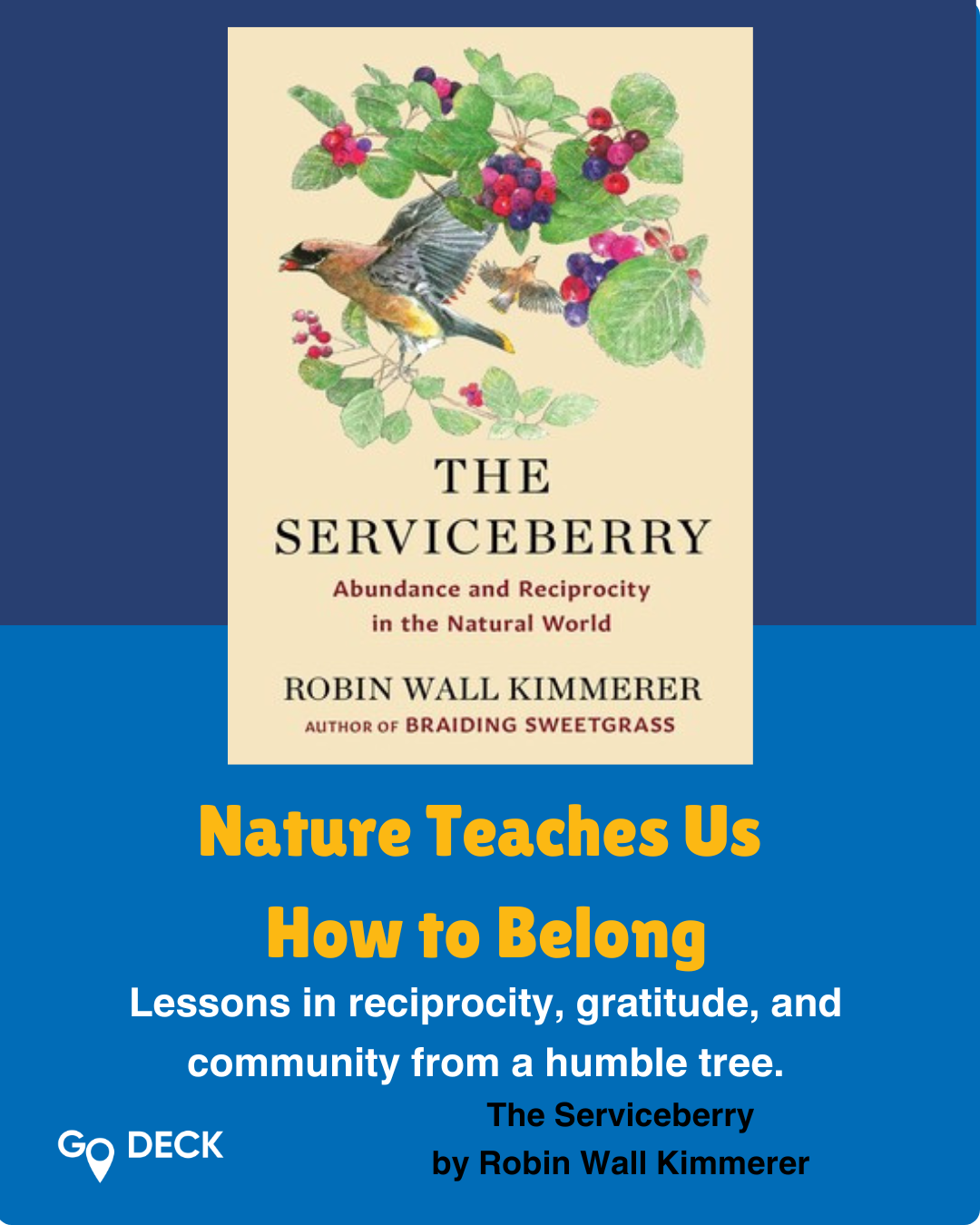
Many books about nature focus on what we can gain from spending time outdoors: better health, lower stress, improved focus, greater happiness, etc...
Robin Wall Kimmerer's The Serviceberry asks a different question: What can nature teach us about how to live together?
Using the humble serviceberry tree as her guide, Kimmerer explores ideas of generosity, reciprocity, gratitude, and community. The book is less concerned with individual benefits and more interested in relationships—between people, between species, and between humans and the natural world.
The result is a thoughtful and hopeful reflection on what we might learn if we paid closer attention to how nature works.

The Big Idea
The serviceberry tree produces an abundance of fruit each year. Birds, animals, and people eat the berries.
Yet, the tree doesn't calculate who deserves them. It doesn't ration its gifts. It simply participates in a larger system of exchange.
Kimmerer uses this example to contrast two different ways of thinking about the world.
One focuses on scarcity, ownership, and competition, while the other focuses on abundance, reciprocity, and mutual support. Nature, she argues, often operates according to the second model.
The serviceberry becomes a symbol of what is possible when we recognize that we are part of a community rather than separate from it.
Reciprocity Is Everywhere in Nature
One of the most powerful themes in the book is reciprocity.
In natural systems, relationships are rarely one-sided.
- Plants provide food and habitat.
- Animals help disperse seeds.
- Pollinators support flowering plants.
- Decomposers recycle nutrients.
Countless species contribute to the health of the larger ecosystem, with each playing a role and each benefitting from the whole.
Kimmerer encourages readers to see themselves as participants in these relationships rather than observers standing outside them. This perspective transforms the way we think about our place in the world.
Belonging Instead of Consuming
Another idea that resonated with me is the distinction between belonging to a place and simply using a place. Modern life often encourages us to think like consumers.
Kimmerer invites readers to consider a different approach. What if we viewed ourselves as members of a community that includes people, plants, animals, and landscapes? Would that change our actions...our sense of responsibility...our sense of connection?
The book asks more questions than providing answers...but that's OK.
Gratitude Changes How We See the World
Throughout The Serviceberry, Kimmerer returns repeatedly to the idea of gratitude as a practice.
When we recognize the countless gifts we receive from the natural world—clean water, food, shade, pollination, beauty, and opportunities for connection—we begin to see our surroundings differently. This shifts our perspective of places into one of relationship.
Why This Book Resonated With Me
One reason I appreciated The Serviceberry is that it expands the idea of what outdoor experiences can offer.
Many of the books I've reviewed in this summer reading series focus on health, attention, curiosity, or discovery.
Those benefits matter, but Kimmerer reminds us that nature can also teach us about community. Trails, parks, rivers, and more connect us to other people, other species, and something larger than ourselves. That sense of belonging may be one of nature's most valuable gifts.
From Observation to Relationship
Recent books in this summer series encouraged readers to pay closer attention to the natural world, but The Serviceberry takes the next step.
- Observation leads to appreciation.
- Appreciation leads to care.
- Care leads to relationship.
Kimmerer suggests that once we begin seeing ourselves as part of a living community, our choices naturally start to change.
The next time you're outdoors, consider not only what you are seeing, but what you are part of.



Share:
San Diego Strolls: Jacaranda’s Purple Season
Innovate 8: Carlsbad teen codes free map to 52 outdoor spots countywide