
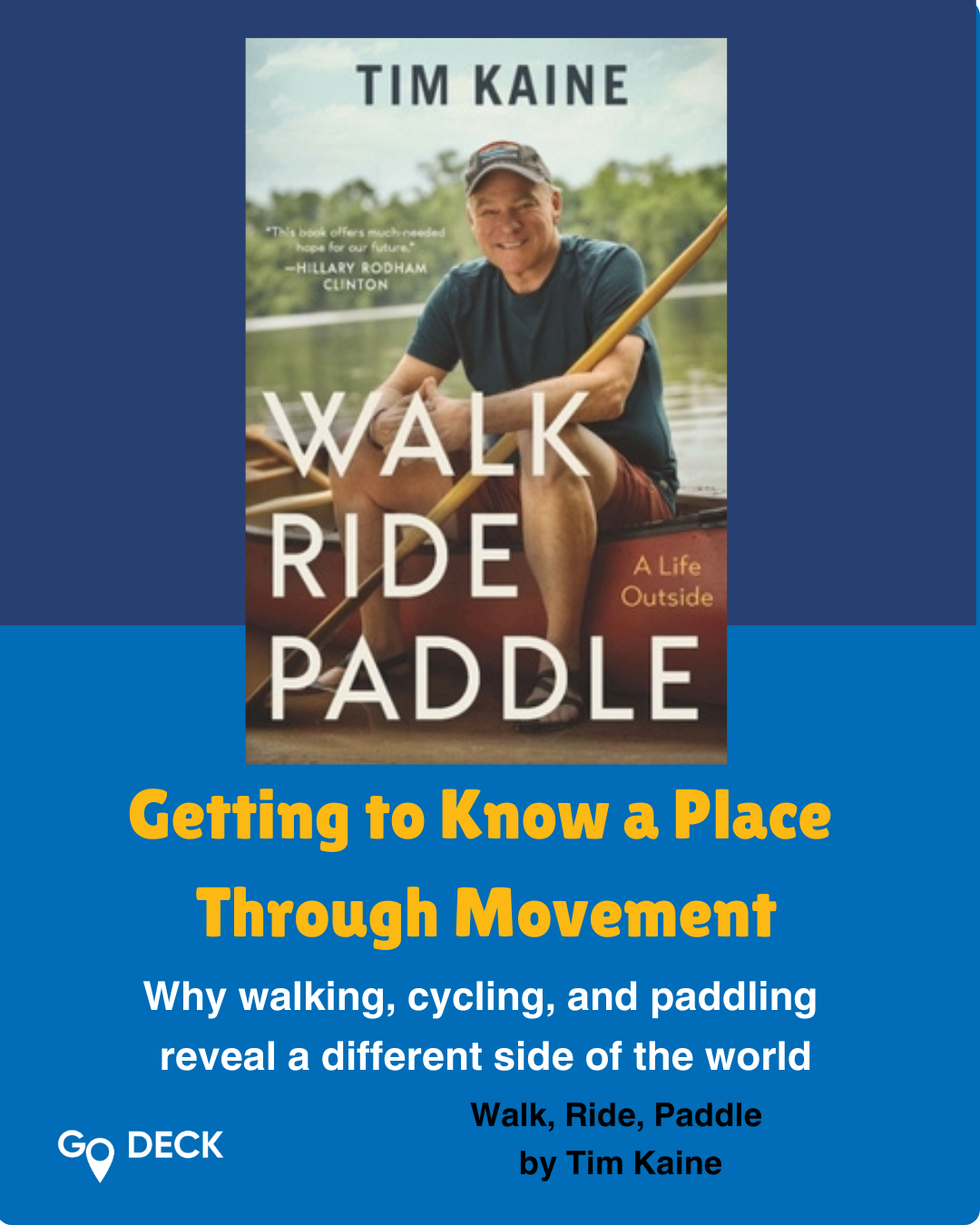
Most of us move through our communities quickly, often driving here, there, and everywhere. The United States, in general, seems set up for getting to places via motorized vehicles.
As a result, we often know how to get around a place without truly knowing it. Tim Kaine's Walk, Ride, Paddle offers a different approach.
In the book, Kaine recounts a year-long journey across Virginia using only three methods of travel: walking, cycling, and paddling. Along the way, he encounters landscapes, communities, wildlife, history, and people that would have been easy to miss from behind a windshield.
While the book is technically about Virginia, its larger message applies anywhere: The way we move through a place influences how deeply we know it.

The Big Idea
At its core, Walk, Ride, Paddle argues that slower forms of travel reveal a different version of the world. I get this because I once zipped around everywhere via bike...when the pandemic hit, I started walking more, and that change of pace changed my perspective of my surroundings.
I noticed details I'd overlooked while rolling by on two wheels. I saw transitions between neighborhoods. I heard birdsong instead of the sound of wind in my ears. I even had more chances to smell seasonal changes.
Walking Changed My Perspective But The World Looks Different From a Bicycle
While slowing down while walking changed by perspective, Kaine discussed the unique perspective offered by cycling.
Bicycles allow us to cover more ground than walking while still remaining deeply connected to the environment.
You can feel changes in elevation and observe neighborhoods gradually transforming from one area to another.
Cycling often reveals the geography of a place in ways that driving obscures. The hills, valleys, rivers, and ridgelines become part of the experience rather than obstacles to overcome.
Waterways Tell Their Own Stories
And then there was the section of the book on paddling. I've dabbled in kayaking, but Kaine's perspective offered more insights.
Many communities were originally shaped by rivers, lakes, and coastlines, yet we rarely experience them from the water itself. Paddling provides an entirely different perspective.
For readers who enjoyed Blue Mind, these chapters also serve as a reminder that waterways aren't just scenic features—they're often central to a region's identity and history.
Movement Creates Connection
The strongest theme throughout Walk, Ride, Paddle is connection. Not just connection to nature, but also to place, people, and local stories.
As Kaine travels across Virginia, he encounters individuals and communities he might never have met had he been traveling by car.
The slower pace creates opportunities for conversation and observation, and this resonated with me because meaningful outdoor experiences often work the same way.
The less we rush, the more we discover.
How We Learn a Place
One of the questions this book prompted me to consider is: How do we truly get to know a place?
It's not through videos on social media or online reviews, and it's not even through reading the cards within The GO Deck (though I hope each card inspires you to GO--pun intended--to that spot).
We learn a place through experience. Now let's Get Outdoors and GO!
Share:
San Diego Strolls: There's no such thing as a "seagull"
San Diego Strolls: The Science Of “Blue Mind” as You Walk Along the Bay